Your A/B test won, so where is the money?
In How your best prospects could be killing your business, we explored how different conversion rates from different groups of potential customers could be steering the conclusions of your test in the wrong direction.
For simplicity, we ignored the importance of cash. But cash is king, so let’s revisit.
As a reminder, we’re analyzing an email experiment for a meal delivery subscription service.
We ran a nice lil A/B test where the test group was sent a highly urgent 10% discount and the control group was sent the normal email experience.
We found a lift, but former members were carrying most of the weight:
- A huge lift in conversion rate from former members
- A drop in conversion rate for everyone else
Then we decided, well, send the test to formers and everyone else gets the normal emails.
But a discount isn’t free. Every buyer who comes in through the test email pays 10% less, so more buyers doesn’t automatically mean more money. This time, let’s see what the implications are on cash, and whether we land at the same conclusion or maybe find a new opportunity.
Questions we’re going to answer:
- What are the immediate cash results of the test?
- What are the projected long-term effects?
- What would we have to observe to build confidence on the long-term cash effects?
The assumptions
As a subscription biz, we care about future cash coming from renewals and upgrades, not just the first bill.
- The base plan is $360/month for 30 meals. Subscribers can upgrade to $600/month for 60.
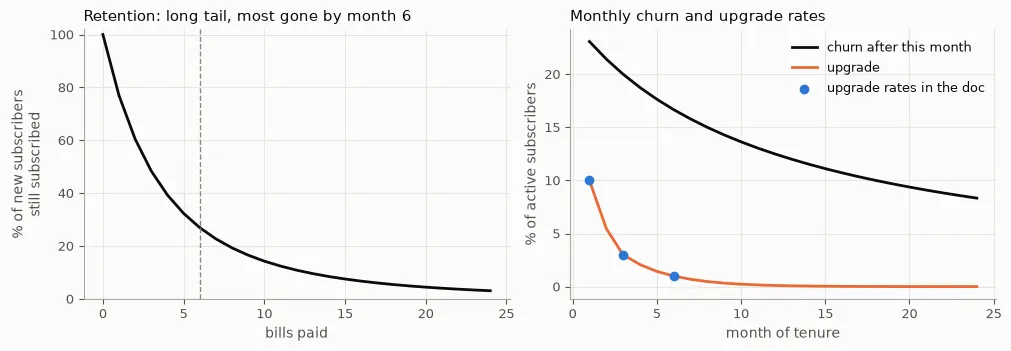
- The average subscription lasts 6 months. Most people who leave do it early: about 23% cancel after their first month, and that drops below 10% for long-time members.
- Most upgrades happen early, too. Each month, 10% of active subscribers upgrade in month 1, 3% in month 3, and about 1% in month 6. Beyond that, practically no one upgrades.
- The test arm gets a lifetime 10% discount on the 30-meal plan, so it pays $324/month. Anyone who upgrades pays the full $600 for the 60-meal plan.
Here’s a look at how our customers typically upgrade and renew each month.
The basic results
Let’s review the results with some basic cash metrics added to our previous cashless analysis.
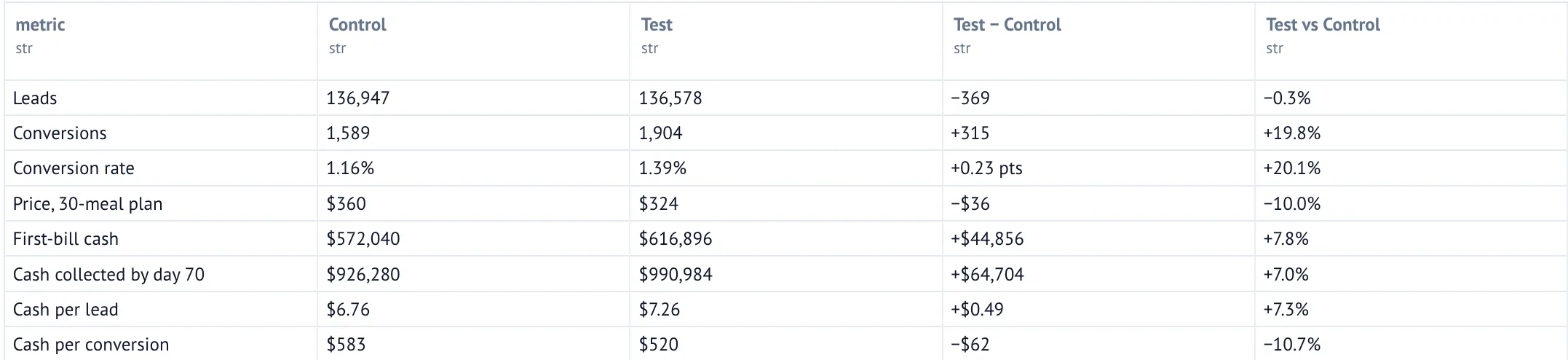
The basic results don’t change. We still see a lift from the test, including notable jumps at certain cash checkpoints: +$45k in immediate cash, +$65k in cash by day 70, and +7% cash per lead.
Notice the one row going the wrong way: cash per conversion is down 10.7%. Each test buyer is worth less. The test still wins on cash because it brought in about 20% more buyers, which more than covers the 10% discount.
Everything points in the same direction. Run with the test cell.
But we ended up deciding to roll with the test for formers and the control for everyone else after stratifying the results. The formers accounted for all of the conversion lift.
What if we choose who gets the discount?
Let’s consider a simple what-if scenario. Based on the results of this test, what kind of cash would we see if we made different choices on which email experience to send to which group?
To keep it simple, picture 100,000 new leads, with a flat 10% of them coming from formers. We apply what we learned about each group, formers and everyone else, and follow the cash for 24 months under each email policy.

Wait, the test email to everyone is flat after 1 month? Didn’t the test just show +7.8% in first-bill cash?
Here’s the catch. To break even on a 10% discount, you need about 11% more buyers. The pooled test happened to come in at +20% more buyers, so it cleared the bar easily. But when we rebuild the result from each group’s conversion rates, at a 10% former mix, sending the test to everyone gets us only about 11% more buyers. That’s just enough to cover the discount, and no more. Same lift in buyers, very different story in cash.
Over time, sending the test to everyone does pull ahead a little. It has more subscribers, so it has more people who can upgrade, and upgraders pay full price. That gets us to about a 2% lift in cash over 24 months. A much less exciting result than our conversion-rate-focused conclusion.
But if we enact that policy of sending the test to formers and the usual emails to everyone else, we project a 28% lift in cash!
This works because we stop paying for the discount where it doesn’t help. Everyone else keeps paying full price and converting at their normal rate, and the discount goes only to the group it actually moves.
We’re back where we started, with an exciting result to share from our stratified analysis of this email experience.
Can we trust our assumptions?
Well, hold up just a minute…
We’re making a crucial mistake. Two big assumptions that we may be overlooking:
- The discount converters will renew just like the normal-priced buyers.
- The discount converters will upsell just like the normal-priced buyers.
What if they don’t? When we’re talking about different customers and members, especially those who buy at a discount, this is a big “what if.”
Intuitively, we can guess that a discount buyer is probably:
- Less likely to spend more money on an upsell
- Less likely to renew a service they bought at a discount
The question we’re really trying to solve is:
How much worse can they be at upgrading and renewing that still doesn’t erode the lift we saw in this test?
If we’d made the bad call of rolling out the test to everyone, it would only take lifetimes 2.8% shorter to wipe out the gains we saw from the test. That’s a razor-thin margin.
If we uncovered the smarter opportunity of just rolling out the test to formers, it would take lifetimes getting cut by more than half to wipe out the gains.
How much room do we have?
Let’s look at a decision boundary built from what we know and what we observed.
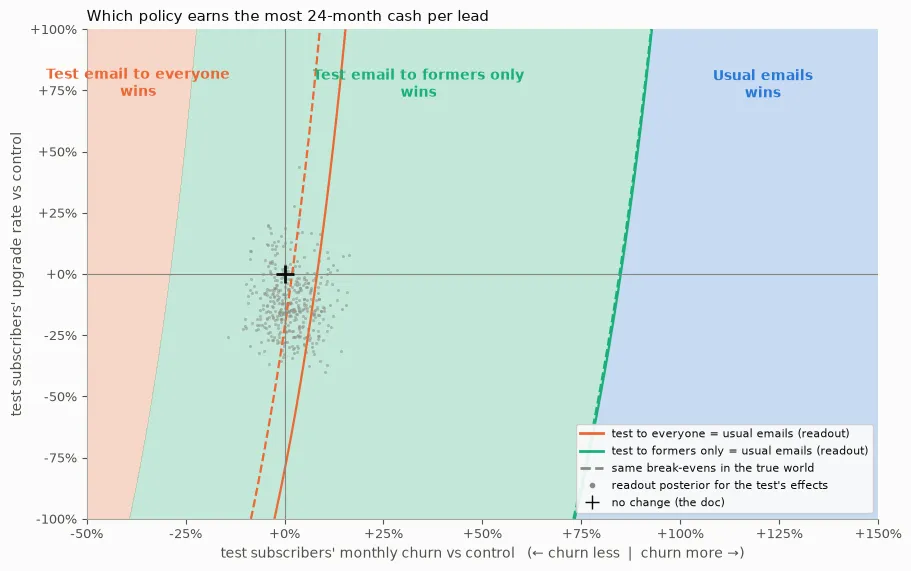
Each spot on the chart is a possible world. Moving right means discount buyers cancel faster than full-price buyers. Moving down means they upgrade less. The color tells you which email policy makes the most money in that world.
The gray dots are what our test data says is plausible. Two things jump out:
- Test to everyone is a coin flip. The dots sit right on top of its break-even line. A little extra churn from discount buyers, well within what we’ve seen, and it loses money compared with doing nothing.
- Test to formers only is a safe bet. Every dot sits deep inside its zone. Discount buyers would have to cancel about 85% faster than full-price buyers before the usual emails win.
If we’re smart, we have tons of room to still win even if we end up seeing drag in upgrades or renewals.
What to watch next
Our job of analyzing this test doesn’t stop when the test stops. Rolling out to formers is the call, but we should keep checking the two numbers this whole decision rests on:
- Upgrade rate for discount subscribers. Most upgrades happen in the first 3 months, so this one shows up fast. Within a quarter, we’ll know whether discount buyers upgrade like everyone else.
- Monthly churn for discount subscribers. This takes longer to settle, because people keep leaving for months. Compare it with full-price subscribers who started at the same time, and watch where it lands on the chart above.
As those numbers come in, the cloud of gray dots gets tighter, and we’ll know where we actually stand. If discount buyers start drifting toward that 85% line, it’s time to rethink the offer. Until then, we keep the win.
We update our beliefs and our conclusions when information allows us to do so.
The takeaway
A lift in conversions is not a lift in cash. When a test changes the price, count the money, and keep counting after the first bill.
Consider the long-term effects. They can drive you crazy if you don’t.